Wednesday, 6 November 2024

Worksheet-Cultural studies

 Worksheet on cultural studies 


Hello everyone, 

This blog is based on worksheet task assigned by prof. Dr. Dilip barad sir . In this blog I will use the AI  for the understanding of the concept of Cultural Studies. The aim of this task, is to critically engage with key concepts in contemporary cultural studies using AI as a learning tool.


Slow Movement :

The slow movement is a cultural movement that advocates for slowing down the pace of human life. It emerged from the slow food movement, which was founded by Carlo Petrini in 1986 in response to the opening of a McDonald's restaurant in Rome's Piazza di Spagna. Petrini was concerned about the increasing globalization and homogenization of food, and he believed that it was important to preserve local food traditions and to promote sustainable agriculture. The slow food movement quickly gained traction, and it soon spread to other countries around the world.


In the 1990s, the slow movement began to expand beyond food to other areas of life, such as work, leisure, and travel. This broader movement is often referred to as the "slow life" movement. The slow movement has had a significant impact on the way that people think about time, work, and consumption. It has helped to promote a more sustainable and equitable way of life, and it has encouraged people to slow down and appreciate the simple things in life.


Principles of the slow movement: 

The slow movement emphasizes the importance of quality over quantity. This means taking the time to do things well, rather than rushing through them. The slow movement encourages people to slow down and savor the present moment. This means paying attention to the details of life and appreciating the small things. The slow movement promotes social and environmental responsibility. This means building relationships with others and working to protect the planet. Mindfulness: The slow movement encourages people to be mindful of their thoughts, feelings, and actions. This means being present in the moment and making conscious choices.


The slow movement is a diverse and growing movement that is having a positive impact on the world. It is a reminder that we don't have to live at a breakneck pace, and that we can choose to slow down and enjoy life.


(WE ARE SLOW FOOD)


Dromology:- 


Dromology, a term coined by the French philosopher Paul Virilio, is a theory that explores the impact of speed on society, culture, and politics. It derives from the Greek word "dromos," meaning "running" or "course," and focuses on the ways in which speed has become a dominant force shaping our world. Dromology argues that speed is not merely a technological advancement but a fundamental factor that shapes our understanding of time, space, and reality. 


A Relevant Example:

The rise of the internet and digital technologies is a prime example of dromology in action. The rapid dissemination of information and the constant connectivity it enables have accelerated the pace of life and transformed the way we communicate, work, and consume media. While these technologies have brought numerous benefits, they have also contributed to a culture of instant gratification, information overload, and a decline in attention spans.


Dromology and Contemporary Society:

Dromology has significant implications for contemporary society. As technology continues to advance, the pace of life is likely to accelerate further. This can lead to increased stress, anxiety, and a sense of alienation. To mitigate these negative effects, it is essential to cultivate a balance between speed and slowness. This might involve practices such as mindfulness, meditation, and spending time in nature. Additionally, it is crucial to critically examine the impact of technology on our lives and to develop strategies for responsible and ethical use.

In conclusion, dromology offers a valuable framework for understanding the profound impact of speed on our society. By recognizing the potential pitfalls of an overly accelerated world, we can work to create a more balanced and sustainable future.


Risk Society:- 


Risk Society is a sociological theory that examines how societies increasingly organize themselves around the management of risks. Coined by Ulrich Beck, this concept suggests that modern societies have shifted from a focus on traditional industrial risks (like pollution) to a broader range of risks, often abstract and global in nature. (Risk)


Postfeminism :- 


Postfeminism is a complex and often contested concept, often characterized by a belief that feminism has achieved its goals and that gender equality has been attained. It suggests that women can now freely choose their roles and identities without the constraints of traditional gender norms. Postfeminism emphasizes individual choice and agency, rather than collective action and solidarity. It often equates female empowerment with consumerism and the pursuit of personal success. 


Example

The rise of "girl boss" culture is often seen as an example of postfeminism. This trend celebrates female entrepreneurship and success, but it can also reinforce traditional gender roles and expectations. While it empowers women to pursue their careers, it may also perpetuate the idea that women must be both successful and conventionally feminine. (Marchray)

Postfeminism has both positive and negative implications for contemporary society. On the one hand, it can empower women to challenge traditional gender roles and pursue their ambitions. However, it can also reinforce harmful stereotypes and inequalities.


Hyperreality:- 


Hyperreality is a concept coined by the French philosopher Jean Baudrillard, which describes a condition in which simulations of reality become more real than reality itself. In a hyperreal world, the distinction between what is real and what is simulated becomes blurred, leading to a culture where the artificial often surpasses the authentic. Theme parks like Disneyland provide a prime example of hyperreality. These parks create highly stylized and idealized versions of reality, where visitors can immerse themselves in fantastical worlds. The experience is so immersive that it can be difficult to distinguish between the real and the simulated. Moreover, the proliferation of virtual reality and augmented reality technologies further blurs the lines between the real and the virtual. As these technologies advance, it becomes increasingly difficult to discern what is authentic and what is simulated. (Jameson)


EX.


Hypernodernism


Hypermodernism is a cultural and social condition that emerges from the rapid acceleration of technological and societal change. It is characterized by a constant state of flux, a blurring of boundaries between the real and the virtual, and a pervasive sense of uncertainty. The rise of social media platforms like Instagram and TikTok exemplifies hypermodernism. These platforms create a constant stream of perfectly curated images and videos, blurring the line between reality and fantasy. 


Users are encouraged to present idealized versions of themselves, leading to a culture of comparison and dissatisfaction. Hypermodernity has profound implications for contemporary society. The constant acceleration of change can lead to feelings of anxiety, stress, and alienation. The fragmentation of social structures can erode our sense of community and belonging. And the pervasive influence of consumer culture can lead to materialism and a loss of meaning. (Cooper,Hypermodern)


Examples :-

Blade Runner (1982): This film depicts a futuristic, dystopian city that is both hyper-real and hyper-modern, with its towering skyscrapers and advanced technology.


Cyberfeminism 


Cyberfeminism is a feminist approach that examines the relationship between technology, cyberspace, and gender. It emerged in the late 20th century, drawing inspiration from third-wave feminism, post-structuralism, and the critique of women's erasure in technology discussions.


Key characteristics of cyberfeminism include:

  • Utopian vision: Early cyberfeminists saw cyberspace as a space free from traditional gender roles and societal constraints, offering opportunities for self-expression and empowerment.
  • Technological appropriation: Cyberfeminists advocate for women's active engagement with technology, aiming to challenge and subvert patriarchal power structures embedded within it.
  • Body and machine: Cyberfeminism explores the blurring of boundaries between the physical and digital realms, questioning traditional notions of identity and embodiment.
  • Networked activism: Cyberfeminists utilize online platforms and networks to build communities, raise awareness, and mobilize for social change.


A relevant example of cyberfeminism is the work of VNS Matrix, an Australian cyberfeminist art collective. Their online manifestos and interactive art pieces challenged traditional gender roles and explored the potential of virtual reality for feminist expression.

Example:- 

Ex Machina (2014) movie: 


Ava, the AI character, blurs the lines between human and machine, raising questions about consciousness and identity.


In contemporary society, cyberfeminism remains relevant due to:

  • The increasing role of technology in daily life: As technology becomes more pervasive, understanding its impact on gender and identity is crucial.
  • The persistence of gender inequality online: Cyberfeminism highlights the online harassment, discrimination, and misrepresentation that women face in digital spaces.
  • The potential of technology for social change: Cyberfeminism emphasizes the power of technology to empower marginalized groups and challenge oppressive systems.


Potential implications of cyberfeminism include:

  • Demanding greater representation of women in technology fields: Encouraging women to pursue careers in STEM to challenge gender stereotypes and biases.
  • Promoting ethical and inclusive technology design: Ensuring that technology is developed with consideration for diverse users and avoids reinforcing harmful gender norms.
  • Advocating for digital rights and online safety: Fighting for women's right to access and use technology safely and without fear of harassment or discrimination.
  • Exploring new forms of feminist expression and activism: Utilizing digital tools to create innovative and impactful feminist art, activism, and community-building.

 Cyberfeminism offers a critical lens for examining the intersection of technology, gender, and power. By understanding its key concepts and contemporary relevance, we can work towards a more equitable and inclusive digital future.


Posthumanism 


Posthumanism is a philosophical and cultural movement that challenges traditional notions of what it means to be human. It explores the idea that the boundaries between humans and other entities, such as machines, animals, or even the natural world, are becoming increasingly blurred.(Oxford Bibliography)


Types of Posthumanism:

  1. Technological Posthumanism: This perspective focuses on the impact of technology on human identity and the possibility of transcending biological limitations through technological enhancements. 
  2. Cultural Posthumanism: This approach emphasizes the cultural and social construction of the human subject and explores how these constructions are being challenged by globalization and digital culture.  
  3. Philosophical Posthumanism: This branch delves into the philosophical implications of posthumanism, questioning traditional concepts of consciousness, subjectivity, and personhood. (Kn,Wilson

Examples:- 

Her (2013): This film explores the concept of human-AI relationships, questioning the boundaries between human and machine.


Interconnections Between the Concepts:- 

These concepts, while distinct, are interconnected by their shared exploration of the complexities of contemporary society, particularly in the age of technology and globalization.

Speed, Time, and Space

Dromology and Hypermodernism are closely linked, both focusing on the acceleration of speed and the compression of time and space. Dromology, in particular, explores the societal and cultural implications of speed, while hypermodernism delves into the rapid changes and complexities of modern life.

Slow Movement can be seen as a reaction to the relentless pace of hypermodernity, advocating for a slower, more mindful approach to life.

Technology and Society

Cyberfeminism and Posthumanism both engage with the impact of technology on identity, gender, and the human body. Cyberfeminism, in particular, explores the potential of technology to challenge traditional gender roles and power structures. Posthumanism, on the other hand, questions the very notion of a fixed human identity, suggesting that technology can blur the boundaries between humans and machines.

Hyperreal and Risk Society are both influenced by the pervasive nature of technology and media. The hyperreal refers to the blurring of the lines between reality and simulation, while the risk society highlights the increasing prevalence of manufactured risks, often associated with technological advancements.

Power and Identity: 

Postfeminism and Cyberfeminism are both concerned with gender and power, but they approach these issues from different perspectives. Postfeminism explores the complexities of gender identity in contemporary society, while cyberfeminism focuses on the potential of technology to challenge traditional gender roles.

Risk Society and Postfeminism are linked by their shared interest in social inequalities and marginalized groups. Both concepts highlight the ways in which certain groups are more vulnerable to risks and social injustices.


By understanding these interconnections, we can gain a deeper appreciation for the complexities of contemporary society and the challenges and opportunities that lie ahead.(Gemini AI)


References:

1) About Us.” Slow Food, https://www.slowfood.com/about-us/. Accessed 6 November 2024.

2) Cooper, Brent. “The Hypermodern Highway to Hell. Cultures of Excess and the Dark Side of… | by Brent Cooper | The Abs-Tract Organization.” Medium, 13 October 2020, https://medium.com/the-abs-tract-organization/the-hypermodern-highway-to-hell-1d3a6441b540. Accessed 6 November 2024.

3) Gill, R. (2007). Postfeminist media culture: Elements of a sensibility. European Journal of Cultural Studies, 10(2), 147-166. https://journals.sagepub.com/doi/epdf/10.1177/1367549407075898. Accessed 6 November 2024.

4) Jameson, Fredric. “(PDF) Hyperreality and Simulacrum: Jean Baudrillard and European Postmodernism.” ResearchGate, https://www.researchgate.net/publication/318535157_Hyperreality_and_Simulacrum_Jean_Baudrillard_and_European_Postmodernism. Accessed 6 November 2024.

5) Kd, Wilson, and Neil Badmington. “(PDF) Technological Posthumanism and Human-Machine Symbiosis.” ResearchGate, 7 July 2023, https://www.researchgate.net/publication/372166520_Technological_Posthumanism_and_Human-Machine_Symbiosis. Accessed 6 November 2024.

6) Kivijärvi, M. (2021), "“Stop whining and be a badass”: a postfeminist analysis of university students' responses to gender themes", Equality, Diversity and Inclusion, Vol. 40 No. 6, pp. 690-707. https://doi.org/10.1108/EDI-08-2020-0219. Accessed 6 November 2024

7) Machray, Kim. “Girlboss: What Does it Mean to be a Feminist in a Capitalist World?” Empoword Journalism, 25 March 2023, https://www.empowordjournalism.com/all-articles/girlboss-what-does-it-mean-to-be-a-feminist-in-a-capitalist-world/. Accessed 6 November 2024.
8) “Risk society.” Oxford Reference, https://www.oxfordreference.com/display/10.1093/oi/authority.20110803100422576. Accessed 6 November 2024.
9) Schweigert, Sabine. “Dromology: Media, speed and a negative horizon.” Medium, 8 August 2022, https://medium.com/@SDNue_Social_Design/dromolgy-media-speed-and-a-negative-horizon-4d05b71383f0. Accessed 6 November 2024.
10) Schneider, Stephen. “Good, Clean, Fair: The Rhetoric of the Slow Food Movement.” College English, vol. 70, no. 4, 2008, pp. 384–402. JSTOR, http://www.jstor.org/stable/25472277. Accessed 6 Nov. 2024.
Note: Also I used GEMINI AI for generating my answers. 

Thank you so much for reading.

Have a great time.

Sunday, 3 November 2024

Cultural Studies: Media, Power & Education

 Cultural Studies, Media, Power, and the

 Truly Educated Person

Hello everyone , 

This blog is part of thinking activity on Cultural Studies, Media, Power, and the Truly Educated Person given by Dilip Barad sir.


Media and Power : 


Media—whether it's in newspapers, TV, or on social platforms—helps powerful groups like governments and big companies spread their messages. For example, during elections, ads and social media posts shape how people think and influence their voting choices. By controlling what we see and hear, those in power can shape how we understand events, giving them an advantage in influencing public opinion.

Eric Liu explains that power is always growing and changing, and the media plays a big part in helping those in power gain even more influence. When a politician becomes popular on social media, more people tend to support them, which can lead to changes in policies. Media doesn’t just show power; it also helps make power stronger.

Powerful people and groups use media like TV, social platforms, or newspapers to present themselves in a positive way. This affects how the public sees issues like elections and policies. We see this when social media trends change how people respond to certain events or when the news highlights specific voices, shaping what we think is important.

By using media, those in power can keep growing their influence, as Eric Liu mentions. Since power constantly shifts, the media plays a key role in deciding who holds influence at any time. Understanding how the media works can help us see how our opinions and decisions are being shaped by those in power.


Media-Power and Modern Culture :

Media and power work together to shape modern culture. Powerful groups, like governments and big companies, often control or influence media to promote ideas or products that suit their interests. For example, governments use news to push political agendas, while companies use ads to promote consumerism. This shapes what we see as normal or true. Media doesn’t just show what’s happening; it also affects how we think about the world. News, movies, TV, and social media highlight certain views while ignoring others. For instance, mainstream media often focuses on topics that benefit those in power and gives less attention to marginalized voices, shaping how we understand important issues and events.

Education


The very traditional education focuses on learning a set curriculum, memorising facts, and following standard knowledge. However, true education goes beyond this. It encourages curiosity, questioning the norm, and thinking critically. A truly educated person doesn’t just know different subjects but can think deeply, come up with new ideas, and see learning as a lifelong, self-driven process.

Being "truly educated" today means more than just gaining knowledge from books or classrooms. It involves handling the constant stream of information from the media. A truly educated person thinks critically, questions information, and looks for different viewpoints.

They also understand the media’s influence and the power behind it. A truly educated person remains open-minded, willing to change their views based on new information. Media literacy is important too, as it helps them identify reliable sources, understand how media messages are made, and spot biases or misinformation.

This idea matches Noam Chomsky’s view that true education leads to intellectual freedom. He believes that education should encourage people to discover things on their own and question even well-established ideas. In contrast, traditional education can sometimes limit creativity by focusing too much on memorization and exams.

In a world filled with misinformation, being truly educated means knowing how to check facts independently. Instead of relying only on mainstream media, a truly educated person seeks out different perspectives and uses various sources to find the truth, maintaining intellectual independence in today’s media-driven society.


Critical Media Consumption:


Critical media literacy is important, in today’s media-filled world. It means being able to analyse and evaluate media content instead of just accepting it. Critical media literacy helps people understand hidden messages in what they see, hear, or read by asking questions like: Who created this message? What is its purpose? How is it affecting me? Teaching media literacy helps spot biases, see how power shapes media, and recognize misinformation, especially on social media where false information spreads quickly.

By learning to critically engage with the media, people become more aware, think independently, and make informed decisions. It helps them see through propaganda, question dominant views, and seek different perspectives.

The rise of social media has made this problem worse. Platforms like Facebook and Twitter show users content they already agree with, creating echo chambers where differing opinions are less accepted. Misinformation, especially from biassed news, also spreads quickly, reinforcing incorrect beliefs.

Jay Van Bavel suggests a few ways to reduce cognitive dissonance: First is , Acknowledge personal bias: Everyone has biases, so recognizing that we all see the world through our own lens can help us be open to new ideas. Secondly we have this , Question assumptions: Instead of accepting information without thought, we should challenge our beliefs and think critically about the sources. Then after Warn others about misinformation: Alerting people to the risks of misinformation encourages them to fact-check and be more critical.

Media has a big impact on how we view the world and make daily choices. News, social media, TV shows, and ads influence our understanding of politics, what we think is important, and even the products we buy. For instance, watching news from only one political perspective can shape our thinking, and social media influencers can affect our views on fashion or trends without us realising it.

How Media Affects Worldview and Daily Choices

Media significantly influences our worldview and daily decisions. Each day, we are impacted by news, television programs, social media content, and advertisements. For instance, the news shapes our understanding of political matters, while social media affects our perception of what is popular or significant. Media also guides our choices, such as which products we purchase, what trends we follow, and how we view specific issues.

For example, if a person primarily consumes news from one political viewpoint, they may start adopting that perspective across their thinking, often unconsciously. Likewise, social media influencers can shape our sense of style and what we consider fashionable.

Saturday, 2 November 2024

The Wretched of the Earth

 The Wretched of the Earth

by Frantz Fanon

Hello everyone...

This blog is based on the thinking activity assigned by Megha Trivedi ma'am , under the Postcolonial studies. In this blog I am going to discuss some question and answers based on the Wretched of the Earth. Before moving towards our main Q&A let's have a brief look on author and the work.


The Wretched of The Earth


Frantz Fanon 


Frantz Fanon (born July 20, 1925, Fort-de-France, Martinique—died December 6, 1961, Bethesda, Maryland, U.S.) was a West Indian psychoanalyst and social philosopher known for his theory that some neuroses are socially generated and for his writings on behalf of the national liberation of colonial peoples. His critiques influenced subsequent generations of thinkers and activists.


The title “The Wretched of the Earth”: 

The title "The Wretched of the Earth" comes from the book by Frantz Fanon, originally published in French as 'Les Damnés de la Terre' in 1961. The title is significant as it encapsulates the essence of the book's focus on the suffering, struggle, and revolutionary potential of colonized and oppressed people across the globe.

The term "wretched" conveys deep suffering, degradation, and dehumanization. Fanon uses this powerful descriptor to draw attention to the plight of colonized populations who have been subjected to severe oppression and stripped of their dignity and rights by colonial powers. The title signals Fanon's central thesis that liberation from colonization must come through revolutionary violence. He argues that true freedom for the colonized requires dismantling colonial structures and reclaiming power through an often violent struggle. Thus, the “wretched” are those who must rise up to reclaim their humanity and agency.

The title's scope extends beyond one nation or region, indicating that the suffering of the colonized is a universal condition shared across continents affected by colonial rule. It suggests that the book’s ideas are relevant to all places where people have been subjected to colonial subjugation. The phrase "the wretched of the earth" also echoes the opening line of 'The Internationale', a well-known leftist anthem that calls on the oppressed and exploited masses to unite against their oppressors. This connection emphasizes solidarity among the oppressed and the inevitability of revolutionary change. It serves as a rallying cry for the oppressed to recognize their shared condition and potential for collective liberation. It encapsulates themes of struggle, dehumanization, and the call to action that permeate Fanon's powerful anti-colonial work.


According to Fanon, what is wrong with the “racialization” of culture?

Frantz Fanon’s critique of the “racialization” of culture goes beyond a mere intellectual argument; it is central to his understanding of how colonialism operates to oppress and dehumanize the colonized. For Fanon, racialization is not simply the act of associating culture with race but a deliberate and destructive process through which the colonial system essentializes and fixes racial identities in a way that enforces rigid, hierarchical divisions between the colonizer and the colonized. The colonial powers use racial categories to portray the colonized as inherently inferior, primitive, and uncivilized, while presenting themselves as the epitome of cultural superiority, rationality, and civilization. This racialization of culture results in the colonized being relegated to a state of cultural alienation. Their native traditions, languages, and customs are discredited, often reduced to derogatory stereotypes, forcing them into an uncomfortable duality: they are pressured to adopt the colonizer’s culture while simultaneously being made to feel inferior for their own. This alienation is not just psychological but social and political, as it undermines the colonized people’s sense of self-worth and identity.

Fanon argues that this racialization also acts as a tool for maintaining the colonial power structure. By casting the colonized as racially and culturally “other,” the colonizers justify their exploitation, viewing themselves as the bearers of enlightenment and civilization. This creates an ideology that reinforces the moral and intellectual superiority of the colonizer while suppressing the cultural and political autonomy of the colonized. In Fanon’s view, this process goes beyond the psychological damage of inferiority; it is part of a broader strategy of dehumanization that actively seeks to deny the colonized any meaningful agency in their own lives and cultures.

Moreover, Fanon critiques the racial essentialism that underpins this process. The racialization of culture suggests that one’s cultural identity is permanently tied to their race, effectively reducing complex and diverse communities to monolithic, static categories. This denial of cultural fluidity and agency is profoundly limiting, as it erases the dynamic nature of culture and identity. Fanon emphasizes that culture is not a static, pre-determined expression of racial identity but a living, evolving process that should be shaped by the people themselves, free from colonial impositions. In his work, he stresses the need for the colonized to resist and reject these imposed categories, and in doing so, reclaim their cultural identity in a way that reflects their true experiences, aspirations, and histories.

Fanon’s critique of the racialization of culture, therefore, is deeply tied to his broader anti-colonial philosophy. It represents an understanding that the path to liberation requires the colonized to not only dismantle the material structures of colonialism but to challenge and transform the cultural and psychological systems that have been put in place to keep them oppressed. The reclamation of culture becomes an act of resistance—one that empowers the colonized to break free from the colonial gaze and redefine themselves on their own terms. It is through this decolonization of culture, Fanon argues, that true liberation can be achieved, as it allows the colonized to reclaim their humanity and redefine their place in the world without the constraints of colonial racism and cultural domination.


 What is the national bourgeoisie and why does Fanon think it is “useless”?

The national bourgeoisie refers to a class of merchants, industrialists, and professionals who emerge in colonial or semi-colonial societies. They often develop close ties with the colonial power and aspire to its lifestyle. Rather than championing the cause of liberation, Fanon argues that the national bourgeoisie prioritizes self-interest, collaborating with colonial powers to maintain their privileged positions.  Fanon views the national bourgeoisie as inherently incapable of leading anti-colonial struggles. Their pursuit of wealth and status, often at the expense of the oppressed masses, further alienates them from the revolutionary spirit. This class, according to Fanon, lacks the revolutionary zeal and commitment necessary to dismantle the colonial system.  The national bourgeoisie, in their quest for social and economic advancement, often mirrors the decadent aspects of the Western bourgeoisie, adopting consumerist values and neglecting the needs of the masses. This focus on personal gain and social status, rather than collective liberation, further undermines their potential to lead a radical transformation of society.  Fanon believes that true liberation can only be achieved through a radical revolution led by the people themselves, not by a class inherently bound to the colonial system. He argues that the national bourgeoisie, with their vested interests and limited vision, are ill-equipped to lead such a transformative movement.  In conclusion, Fanon considers the national bourgeoisie as "useless" for leading anti-colonial struggles due to their inherent self-interest, lack of revolutionary zeal, and focus on personal gain rather than collective liberation. He believes that only a radical revolution led by the people themselves can achieve true liberation. 

The national bourgeoisie, a group of wealthy merchants, industrialists, and professionals in former colonies, often sided with the colonial powers. Instead of fighting for independence, they prioritized their own interests and worked with the colonizers to maintain their privileged positions. Fanon believed that the national bourgeoisie couldn't lead the fight for freedom because they were more concerned with personal wealth and status. They adopted Western lifestyles and ignored the suffering of the common people. This self-serving attitude made them incapable of leading a radical revolution. Fanon argued that only the people themselves could achieve true liberation. The national bourgeoisie, tied to the colonial system, lacked the revolutionary spirit and vision needed to transform society.

Conclusion : 

In conclusion, Frantz Fanon’s view of the national bourgeoisie underscores their inherent limitations as leaders in anti-colonial struggles. Their self-serving pursuit of wealth and social status, coupled with their collaboration with colonial powers and adoption of Western lifestyles, alienates them from the revolutionary needs of the broader population. Fanon believes that true liberation cannot be achieved through a class that seeks to perpetuate the colonial legacy for personal gain. Instead, he emphasizes that only a radical, people-led revolution can dismantle the colonial system and create a new, just society. The national bourgeoisie's lack of commitment to collective liberation renders them "useless" in the fight for genuine independence and transformation.

Thank you for reading.

have a great time.


Wednesday, 30 October 2024

The curse or karna

The Curse or Karna 

Hello everyone, 

This blogpost is part of thinking activity on   T.P. Kailasama’s The Curse or Karna  given by Megha Ma'am. 

T.P. Kailasam

Tyagraj Paramasiva Iyer Kailasam (Kannada: 29 July 1884 – 1946), was an Indian playwright and prominent writer in the Kannada literature. Literary criticism in Kannada literature is said to have started for the first time by Kailasam in his works.

The curse or karna 

The Curse or Karna is a play by T.P. Kailasam that summarizes the life of Karna from the Mahabharata in five acts. The play explores themes of caste conflict, marginalization, and subaltern identity. It portrays Karna as a tragic figure who was excluded from education and respect because of his low birth. The Curse or Karna was first published on September 10, 1946, and was republished in 1969.

Karna - The Voice of the Subaltern 

Karna’s portrayal in The Curse by T.P. Kailasam is a profound exploration of the subaltern voice, highlighting how marginalized individuals confront the dominant social order. In postcolonial and subaltern studies, the subaltern refers to groups that are socially, politically, and geographically outside the hegemonic power structure. Karna fits this definition perfectly: although he is noble in spirit and heroic in deeds, his status as the son of a charioteer places him at the periphery of the Kshatriya-dominated power structures in the Mahabharata.

Kailasam uses Karna’s character to critique the rigid caste system and social prejudices that silence and oppress capable individuals solely based on their birth. Despite his unmatched skills, generosity, and virtues, Karna is denied the respect and status he rightfully deserves. His plight is emblematic of the subaltern's struggle for a voice in a society that systematically marginalizes them. Karna’s loyalty to Duryodhana stems not just from gratitude but from a shared sense of being outcasts, binding them together as allies against the injustices meted out by a discriminatory society.

Karna’s challenges highlight how societal structures perpetuate inequality and how even the most valiant are bound by the limitations imposed by their birth. His tragic heroism underscores the paradox of his existence: a man of supreme merit bound by the shackles of social stigma, ultimately unable to transcend the label imposed upon him. The curse he suffers reflects the compounded injustices faced by the subaltern—cruel fate adding to societal prejudice.

In-Depth Explanation of Themes in The Curse by T.P. Kailasam

1) Class and Caste Conflict

At the heart of The Curse lies a scathing critique of the caste system and the social hierarchies that perpetuate discrimination. The play uses Karna’s narrative to expose how class and caste determine an individual’s worth and opportunities. Despite his valor, generosity, and deep sense of righteousness, Karna is never fully accepted by society because of his supposed low birth as the son of a charioteer. This theme emphasizes the rigidity of social stratification, illustrating that even the most capable individuals can be rendered powerless by their social status. Kailasam portrays the caste system as not just a social construct but an oppressive mechanism that stifles potential and reinforces inequality.

The play provokes questions about the validity of judging individuals based on lineage rather than character and capability. Karna’s continuous struggle against societal norms represents the pain and frustration experienced by those who are marginalized despite their virtues. Through this, Kailasam seeks to awaken the audience to the harsh realities of social prejudices and challenges the moral integrity of such a system.

2) Fate and Destiny

The theme of fate and destiny is a powerful undercurrent in The Curse, reflecting the ancient belief in karma and the inevitability of cosmic justice. Karna’s life is depicted as one overshadowed by curses and misfortune, despite his noble traits and efforts to rise above his circumstances. The concept of fate in the play suggests that certain aspects of human existence are preordained, and no amount of personal strength or virtue can alter them.

Kailasam uses Karna’s character to highlight the paradox of human agency versus divine will. While Karna embodies effort and aspiration, his trajectory is ultimately governed by forces beyond his control, such as the curse from Parashurama and the divine decree that aligns him against his true kin. This theme underscores the notion that fate can be both blind and impartial, distributing misfortune regardless of merit. It invites the audience to contemplate the extent of free will and the often-unjust nature of destiny.

3) Sacrifice and Loyalty

Karna’s unwavering loyalty to Duryodhana is one of the most poignant themes of the play, showcasing the complex web of human relationships and the sacrifices they entail. Karna’s allegiance stems from gratitude, as Duryodhana was the only one who saw beyond Karna’s social standing and offered him respect and friendship. This bond is depicted as deeper than mere strategic alliance; it represents a profound sense of duty and personal honor.

However, this loyalty comes with significant personal costs. Karna’s adherence to his promise to Duryodhana leads him into moral conflicts, particularly when his actions oppose the rightful cause of his brothers. The theme of sacrifice in The Curse thus highlights the tension between personal ethics and the obligations that loyalty imposes. It asks whether allegiance and honor are worth pursuing when they come at the expense of personal happiness and moral righteousness.

4) Justice and Injustice

The exploration of justice in The Curse brings to light both societal and divine inequalities. Karna’s life is marked by a series of injustices—being denied recognition, cursed despite his innocence, and ultimately betrayed by fate. Kailasam uses these episodes to question whether justice, as understood in human or divine terms, is truly fair.

The play suggests that justice is often unevenly distributed and can be manipulated by those in power. Karna’s treatment by the Pandavas and other higher-caste figures reflects the imbalance in societal structures, where the privileged often wield control over the destinies of the less fortunate. Additionally, the play’s portrayal of divine intervention—seen in Karna’s curses—illustrates a divine justice system that is equally arbitrary and sometimes even harsh. This theme forces audiences to confront uncomfortable truths about fairness, compassion, and the capricious nature of justice.

5) Identity and Recognition

Karna’s quest for identity and his struggle for recognition resonate throughout The Curse. Born as the son of the Sun God Surya but raised by a charioteer, Karna’s true heritage is unknown to him for most of his life. This dual identity creates an inner turmoil that defines his journey. On one hand, he yearns for the respect and status accorded to a Kshatriya; on the other, he embraces his life as a charioteer’s son out of loyalty and love for his adoptive family.

Kailasam portrays Karna as a symbol of the universal search for belonging and acceptance. His longing for recognition, despite being shunned by society due to circumstances of birth, reflects the broader human need for validation and self-worth. The theme of identity is complicated by societal standards that dictate worth based on lineage rather than character. Karna’s tragic struggle to reconcile his sense of self with societal perceptions mirrors the plight of all individuals seeking acknowledgment in a world that often values conformity over authenticity.

Conclusion 

Kailasam’s The Curse is a powerful exploration of themes that are not just relevant to the epic but resonate with universal truths about human nature and society. Karna’s portrayal as the subaltern voice brings to light issues of marginalization, systemic injustice, and the search for identity, while the various themes enrich the narrative with reflections on fate, loyalty, and social inequity. Through The Curse, Kailasam offers a scathing critique of the social systems that bind individuals and an empathetic portrayal of those who fight against them, making it a timeless study of human resilience and tragedy.

Monday, 7 October 2024

Poems

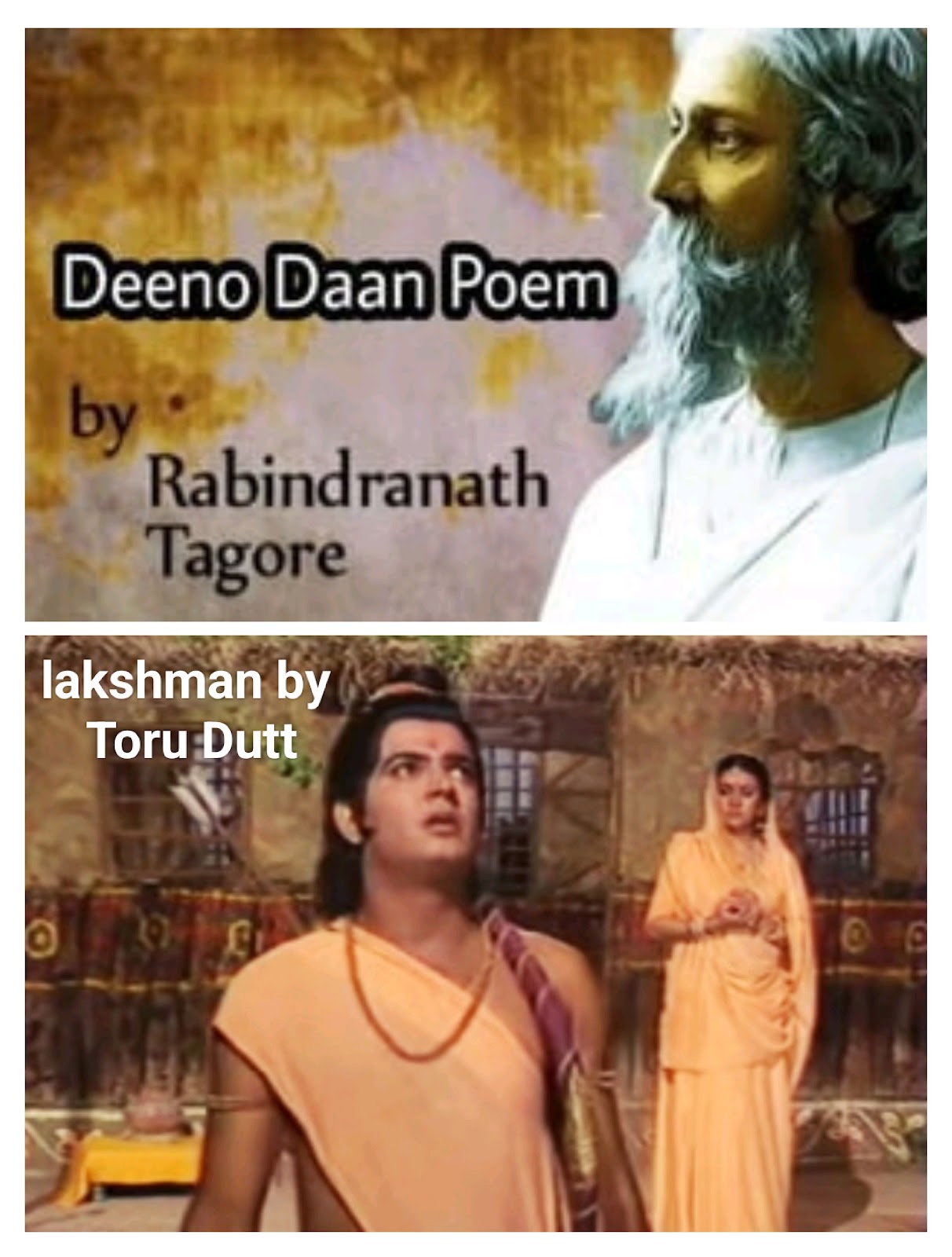
Lakshman & Deeno Daan  

Hello Everyone.....


This blog is based on the thinking activity assigned by Megha ma’am. In which I'm going to discuss two different questions from two poems. The poems are , 1) ‘Lakshman’ byToru Dutt and 2) ‘Deeno Daan’ by Rabindranath Tagore.


1. Can it be said that the dialogues between Sita and Lakshman in the poem Lakshman through light upon the perspective of gender? Explain. 


Yes, of course one can see the dialogues between Sita and Lakshman in Toru Dutt's poem "Lakshman" can certainly be interpreted as shedding light on the perspective of gender, especially in terms of patriarchal values, the role of women in society, and their expression of agency.


In the poem, Sita represents a woman who is deeply committed to her husband's welfare, reflecting the traditional, patriarchal view of women as caretakers of their husbands. Sita's insistence that Lakshman should go after Rama, despite Lakshman's repeated reassurances of safety, highlights her role as a devoted wife. Her character embodies the idealised image of femininity in a patriarchal context—self-sacrificing, emotional, and dependent on male protection.


However, Sita also demonstrates assertiveness, challenging Lakshman's loyalty to his brother. She questions his motives, suggesting that he harbors ill intentions, which reveals a degree of agency and moral questioning. This dialogue demonstrates Sita’s ability to express herself and influence Lakshman's actions, even within the confines of a patriarchal framework. Her agency is somewhat limited by societal expectations, but she does exercise it by appealing to Lakshman’s sense of duty.


Lakshman, in contrast, represents the masculine duty to obey and protect, but he is caught between his loyalty to his brother (Rama) and his concern for Sita’s safety. His rational arguments and sense of duty stand in contrast to Sita’s emotional appeal. This juxtaposition between Lakshman’s rational, duty-bound persona and Sita’s emotional, relational perspective aligns with traditional gender roles where men are seen as protectors and women as vulnerable or needing protection.


Sita’s fear for Rama’s safety and her vulnerability, as expressed in the dialogues, reflect the socially constructed gender roles of women as dependent on men for protection. Lakshman’s refusal to leave her side initially signifies the protective role men are expected to assume. However, Sita's persuasive arguments, particularly when she accuses Lakshman of disloyalty, play on the masculine notion of honor and duty, thereby compelling him to leave her. Her success in convincing Lakshman demonstrates how women in literature often navigate within the boundaries of patriarchal norms to influence outcomes.


From a feminist perspective, the dialogues can be read as an illustration of the tension between patriarchal expectations and a woman's individual desires or emotional needs. Sita's insistence challenges Lakshman’s authority, albeit indirectly. While she adheres to the role of the devoted wife, her emotional appeal and accusations show a subtle form of resistance against male dominance, as she forces Lakshman to act according to her will.


2. What type of social mentality does Rabindranath Tagore present in the poem Deeno Daan?


In "Deeno Daan," Rabindranath Tagore presents a critical view of the social mentality of kings and the upper class. He reflects on their tendency to give out of a sense of superiority, obligation, or for the sake of public display, rather than from genuine compassion or understanding of the needs of the people. The poem suggests that rulers and the upper class often engage in charity or giving to uphold their social image or to maintain power, without truly connecting with or addressing the real needs of the less privileged.


Tagore contrasts this superficial giving with the idea of humble, heartfelt generosity. He implies that the true value of a gift comes not from the wealth of the giver but from their empathy and willingness to treat the recipient with dignity and equality. In doing so, Tagore critiques the mentality of kings and elites who may use charity as a tool for control or self-aggrandizement, urging them to adopt a more humane, selfless approach to serving society.


In "Deeno Daan," Rabindranath Tagore presents a nuanced view of the social mentality of holy men and poor people. Through the figure of the holy man, Tagore critiques the tendency of spiritual leaders or religious figures to sometimes misuse their position by either demanding or expecting offerings from the poor. The holy man in the poem represents a mentality that can be exploitative, where spiritual authority is used to gain material benefits, often without any real connection to the needs or suffering of the poor.


On the other hand, Tagore depicts the poor people as those who give not out of abundance but out of necessity and sacrifice. They may lack material wealth, but their willingness to give, even when they have little, reflects a profound sense of humility and selflessness. Tagore valorizes this mentality, showing how the poor often possess a deeper understanding of the true meaning of charity, driven by empathy and shared struggle.


Overall, Tagore contrasts the exploitative mentality of certain holy men with the genuine, heartfelt giving of the poor, calling for a society that values the spirit of generosity over material wealth or spiritual authority.


Thank you for reading.

have a great time.

Assignment : 209: Research Methodology

  Plagiarism in the Modern Age: Definitions, Forms, Consequences, Detection, and Prevention Personal Details:- Name: Riya Bhatt Batch: M.A...